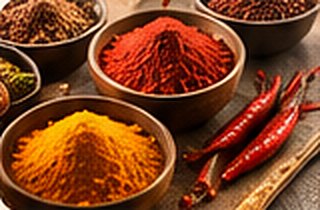
Every Indian kitchen holds a small steel box with seven round tins. It looks ordinary. It is, in fact, one of the most sophisticated flavour systems ever built.
The masala dabba rarely changes from home to home: turmeric, red chilli, cumin, coriander, mustard seed, fenugreek and a wild card — hing in Gujarat, kalpasi in Chettinad, kalonji in Bengal. With just these, a cook can produce hundreds of distinct dishes.
Heat, then fat, then time
The secret is less in the spice than in the sequence. Whole spices bloom in hot oil first, releasing aromatic oils that water alone cannot carry. Ground spices follow, cooked just until the raw edge disappears. Then comes time: a dal makhani at The Spice Courtyard simmers for eleven hours.
“Spices are not added to food. They are cooked into it — that is the whole difference.”
The big four, decoded

From farm to tadka
Most of the black pepper on Tastebox menus comes from Wayanad and Idukki, where smallholders still hand-pick the berries. Erode's turmeric and Guntur's chillies travel to Delhi in under three days, which is why the best kitchens buy whole and grind in small batches.
Next time you order a biryani, notice the layers: the first bite is cardamom, the second is mace, the last is the slow heat of pepper. That is not an accident. It is centuries of craft in one handi.